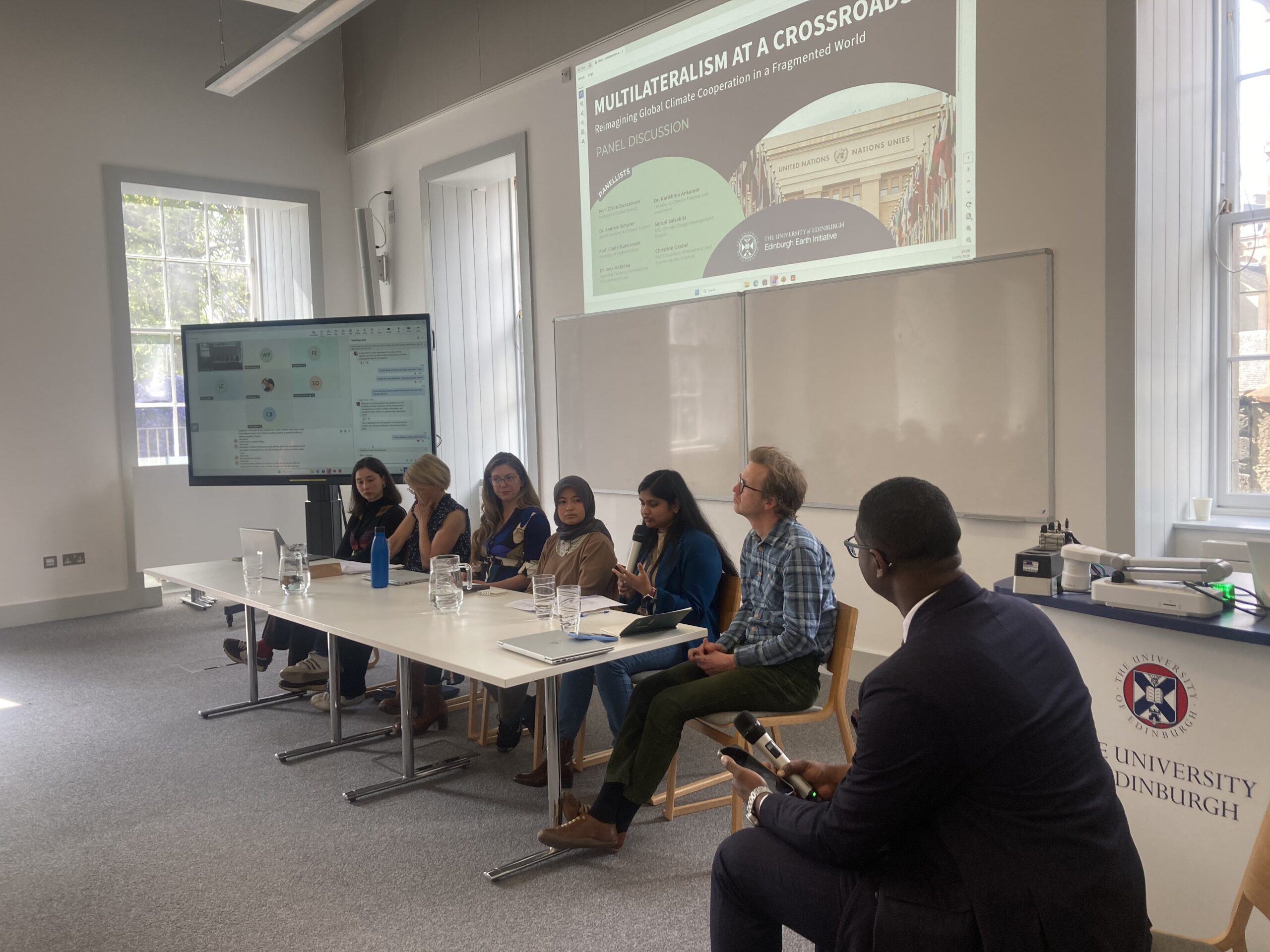
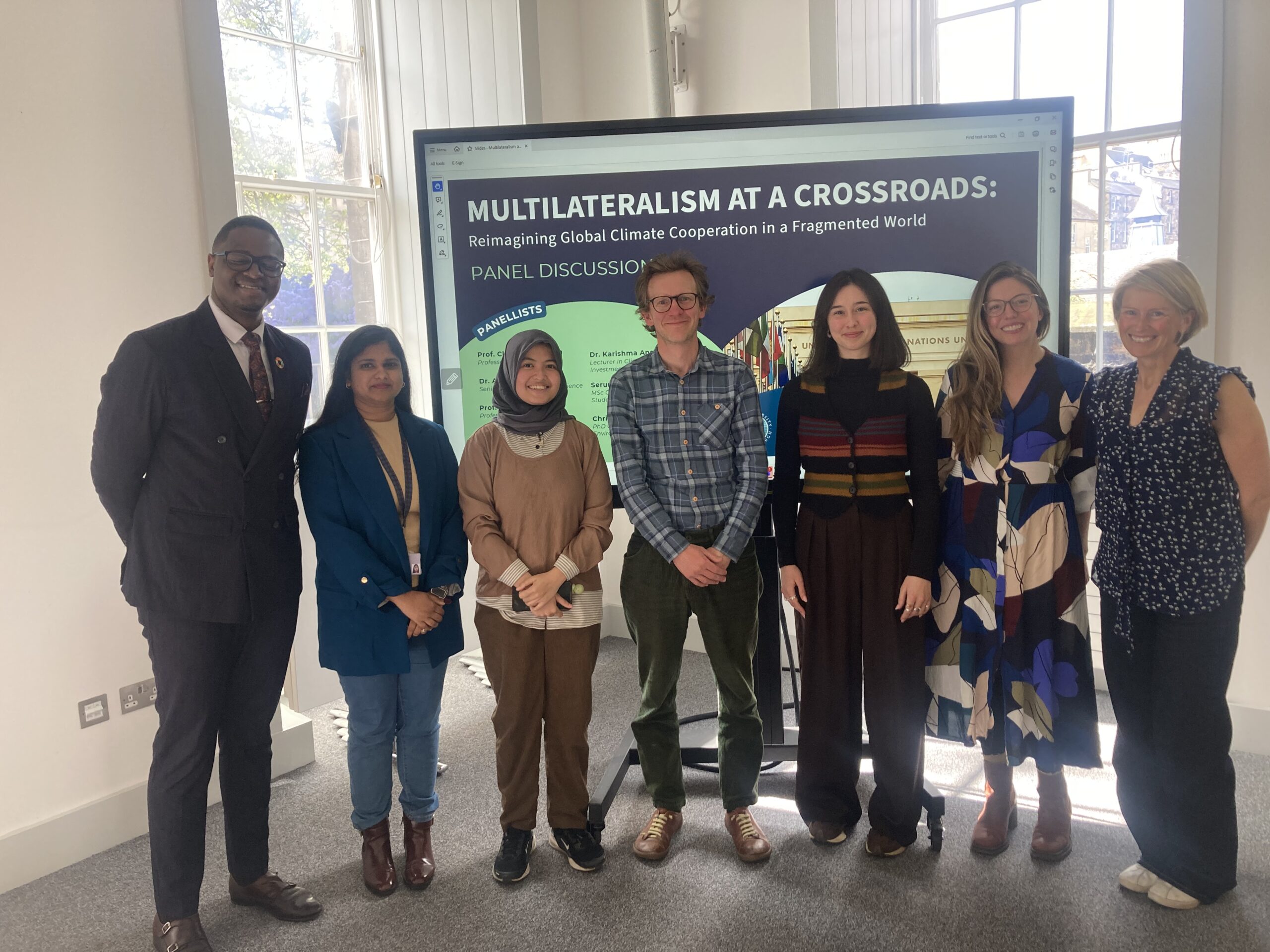
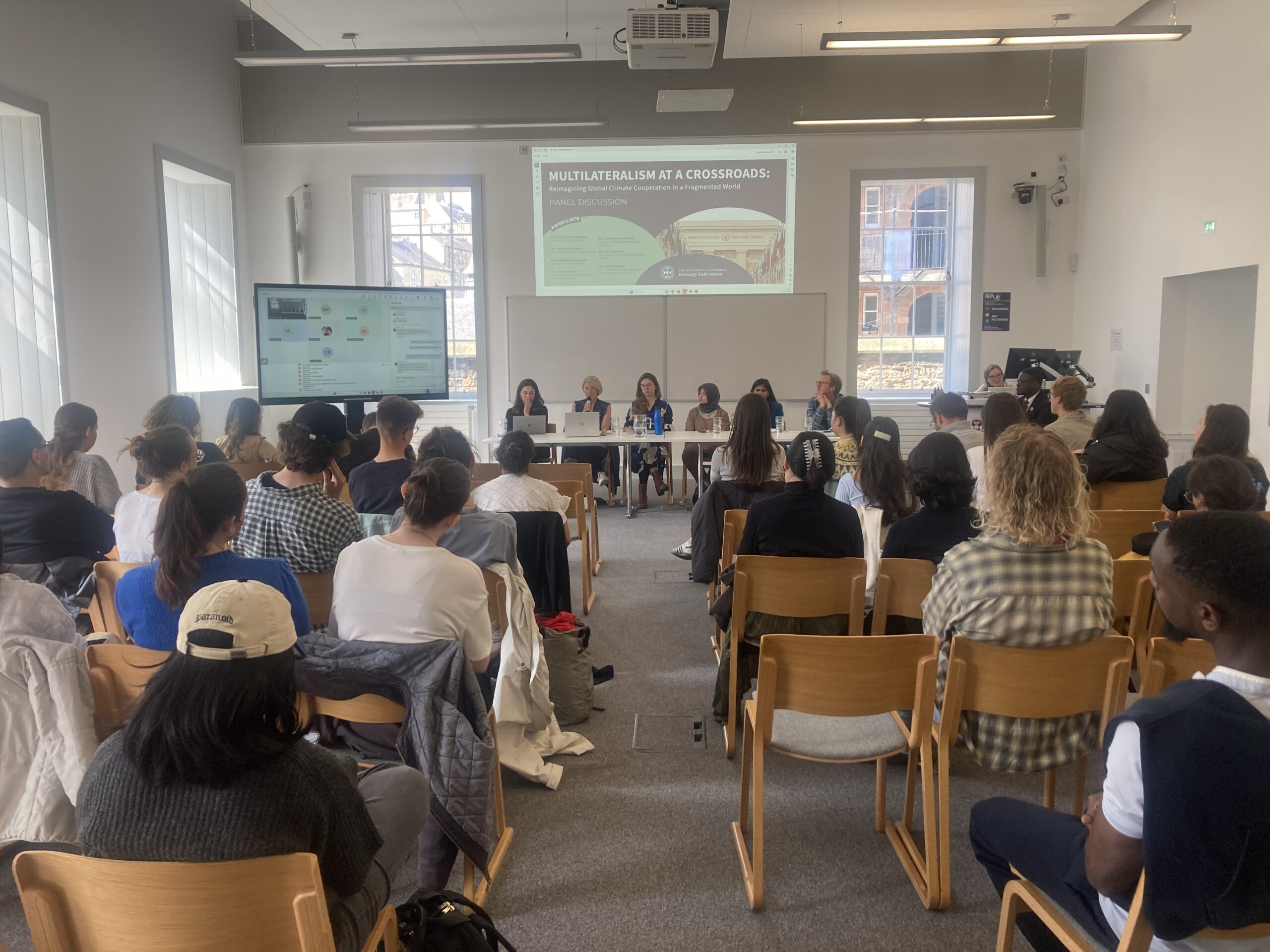
At the heart of today’s climate crisis lies a paradoxical reality: humanity has never been more aware of the urgency of climate action, yet global cooperation appears increasingly fragile. This tension framed discussions at the recent Multilateralism at a Crossroads: Reimagining Global Climate Cooperation in a Fragmented World event, organised by the Edinburgh Earth Initiative.
Bringing together experts in climate science, international law, politics, climate finance, and youth-led climate action, the event provided an important platform for reflection on the future of multilateralism in an era marked by geopolitical tensions, economic instability, and escalating climate impacts.
One of the clearest messages from the event was that multilateralism is not necessarily collapsing; rather, it is transforming. While geopolitical fragmentation, conflicts, and rising nationalism have weakened international cooperation, panellists emphasised that climate governance is evolving in response to these pressures rather than disappearing altogether. The current moment may therefore represent less of an “end” to multilateralism and more of a reconfiguration of how global climate cooperation operates.
From negotiation to implementation
Discussions highlighted that many of the foundational climate agreements the world needs already exist. Instruments such as the Paris Agreement have established key principles, including the 1.5°C temperature goal, common but differentiated responsibilities, and mechanisms for progressively increasing ambition over time.
The challenge today is therefore not necessarily the absence of agreements, but rather the persistent gap between commitments and implementation. Panellists stressed that the future of climate action may depend less on negotiating new treaties and more on ensuring meaningful domestic implementation of existing obligations.
This became particularly clear in discussions on the growing importance of national and city-level action. While international consensus remains important, climate action cannot remain hostage to geopolitical deadlock. Cities, regions, universities, businesses, and local communities increasingly possess the agency to drive transformative change independent of stalled international negotiations.
Climate finance and global inequality
One of the strongest interventions during the event concerned the deep structural inequalities embedded within the global climate finance system. Developing countries, particularly in the Global South, continue to face immense barriers in accessing climate finance despite contributing least to the climate crisis. Debt servicing obligations, currency risks, and high borrowing costs significantly constrain their ability to undertake climate action.
A particularly sobering insight highlighted the fact that debt itself has become a climate issue. Many climate-vulnerable countries are trapped in cycles of indebtedness that limit fiscal space for climate investment while simultaneously pushing governments toward environmentally destructive forms of economic extraction simply to generate foreign currency for debt repayment.
This reality exposes a profound contradiction within the global climate regime: countries most vulnerable to climate impacts are often those least able to finance climate resilience. The discussions therefore reinforced that climate justice cannot be separated from broader questions of economic justice.
While local and regional action is critical, structural challenges such as debt reform and equitable climate finance still require coordinated global solutions.
Climate litigation and accountability
Another key theme from the event was the growing role of climate litigation in strengthening accountability. Panellists reflected on whether climate litigation is emerging as an alternative to weakening multilateral enforcement mechanisms. The consensus, however, was that litigation should complement multilateral agreements rather than replace them.
Recent landmark climate cases such as Urgenda Foundation v. State of the Netherlands and Verein KlimaSeniorinnen Schweiz and Others v. Switzerland demonstrate how courts are increasingly recognising climate change as a human rights issue. These decisions have strengthened the argument that governments possess legal obligations to protect citizens from climate harm and pursue more ambitious climate action.
Importantly, the event highlighted that multilateral agreements and climate litigation are increasingly working together. International agreements such as the Paris Agreement provide important legal benchmarks for litigants, while successful climate cases can place additional pressure on governments to fulfil international commitments.
At the same time, panellists acknowledged the limitations of litigation. Legal action remains expensive, uneven across jurisdictions, and dependent on political will for implementation. Courts can strengthen accountability, but they cannot replace international cooperation.
Science, politics, and the urgency gap
The discussions also returned to the role of science in sustaining trust within a fragmented world. Scientific bodies like the Intergovernmental Panel on Climate Change continue to play a critical role in informing policy and countering misinformation.
Yet one of the greatest frustrations highlighted during the event was the widening gap between what science demands and what politics is delivering. The climate crisis is no longer primarily a problem of insufficient knowledge; it is increasingly a crisis of political implementation.
Looking ahead
Perhaps most importantly, the event underscored the need to sustain hope without complacency. While the geopolitical environment is undeniably difficult, meaningful progress continues to emerge through courts, cities, grassroots movements, regional coalitions, universities, and youth-led initiatives.
As the world moves deeper into uncertainty, one lesson from the event stands out clearly: effective climate action will require both strong international cooperation and bold local leadership. The future of climate governance cannot depend solely on annual negotiations at COPs. It must also be driven by action within nations, institutions, and communities willing to move forward even when global consensus appears elusive.
Ultimately, multilateralism may indeed be at a crossroads, but crossroads are moments of choice rather than defeat. The challenge before the global community is whether it can transform fragmentation into an opportunity for more inclusive, accountable, and action-oriented climate governance capable of meeting the urgency of our time.
Contact
Howard Mwesigwa is an environmental lawyer and climate advocate currently serving as an Earth Fellow at the Edinburgh Earth Initiative. In this role, he supports the COP Engagement project, strengthening student participation in UN climate and environment meetings, including the Conference of the Parties.
He previously coordinated the Parliamentarians for Climate Finance Project in Uganda, led the Energy, Environment & Sustainability Department at Kalikumutima & Co. Advocates, and founded the Climate Action Leadership Incubator Uganda to empower youth in community-based climate action.
Related Posts
Stay up to date with the latest news and stories from the Edinburgh Earth Initiative and across the University of Edinburgh